For Kelli Fritts, the numbers keep running through her mind like an unwelcome mantra.
$889.84: the full price of her silver-level health insurance plan — the cheapest one available for her age group in Denver. $34.17: the amount she actually pays every month. $855.67: the monthly federal subsidy that makes it all possible.
Approaching 60, managing a chronic inflammatory condition, and living on a modest income, Fritts knows that going without health coverage isn’t an option. “There’s no way I’m going to go without insurance,” she said. But as open enrollment for 2026 health plans nears, she and more than 300,000 other Coloradans who buy coverage on their own are staring down a future clouded by uncertainty — and potentially staggering costs.
Waiting for the Numbers That Could Change Everything
With open enrollment just days away, Colorado state regulators have yet to release final premium rates for 2026. The delay stems from ongoing calculations about how pending federal legislation and the possible expiration of enhanced subsidies will impact costs. Regulators expect to release the numbers soon, but that’s small comfort for residents like Fritts, who fear what’s coming.
When insurers submitted their initial rate proposals in July, they requested increases averaging 28% for 2026. State lawmakers have since passed measures that could trim those hikes slightly, but no one expects relief. Fritts has already done her own math — she’s bracing for an 18% increase, or roughly $160 more per month. If Congress fails to renew the federal subsidies that currently offset her premiums, however, the increase could be far worse.
“If the subsidies expire, I’d be paying about $1,050 a month,” she said. “That’s nearly a 3,000% increase. It’s unimaginable.”
Her fear isn’t exaggerated. Colorado’s Insurance Commissioner Michael Conway warned last week that, unless Congress acts soon, people who buy coverage independently could face massive increases — up to 160% statewide on average, and more than 300% in some rural areas. “I don’t think people realize how bad this is going to be,” Fritts said. “And I don’t think there’s a plan for what people are supposed to do.”
How We Got Here: The Subsidies That Saved — and Now Imperil — the Market
Health insurance isn’t something most people think about until they have to, but in Colorado this fall, it’s at the center of a growing storm. To understand why, it helps to look at how the system functions — and why it’s now hanging in the balance.
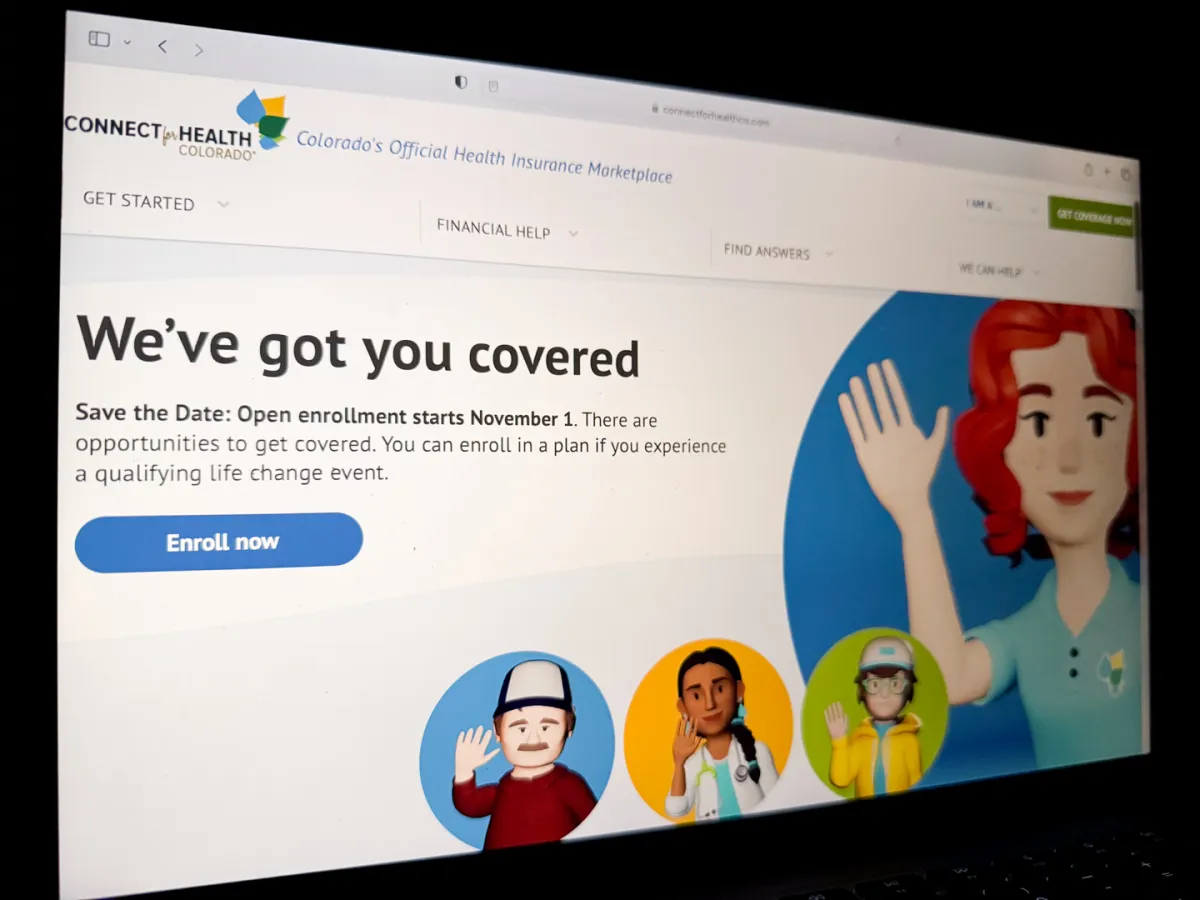
About 40% of Coloradans receive health coverage through government programs like Medicare or Medicaid. Roughly half are covered through their employers, where companies typically pay 70% to 80% of premiums. That leaves about 5% of residents who buy insurance on their own through Connect for Health Colorado, the state’s ACA marketplace. Historically, this group bore the full cost of premiums — until the Affordable Care Act introduced federal tax credits to make coverage more affordable.
During the COVID-19 pandemic, Congress expanded those subsidies. The “enhanced” credits gave extra help to lower-income households and extended eligibility to middle-income families who previously earned too much to qualify. These enhanced subsidies played a huge role in keeping millions insured during the pandemic, even as health care costs continued to rise.
Now, those subsidies are set to expire at the end of the year — and Congress has reached an impasse over whether to renew them. The resulting standoff has shut down the federal government and left millions of Americans, including hundreds of thousands of Coloradans, in limbo.
The Human Cost of Policy Gridlock
If the subsidies vanish, the consequences will be immediate and severe. The state estimates that between 75,000 and 100,000 Coloradans could lose coverage entirely, unable to afford the steep jump in premiums. Those who remain insured will pay drastically more — and because many of the people dropping out are healthier, the overall insurance pool will become sicker and more expensive, pushing premiums even higher in a destructive feedback loop known as adverse selection.
“We’re about to hear stories that are going to be tragic,” Commissioner Conway said at a recent press conference. “Families choosing between paying their mortgage or keeping access to health care.”
It’s a scenario that echoes what happened before the ACA, when buying individual insurance was often financially out of reach for middle-class families. The ACA subsidies helped reverse that trend; without them, the progress of the past decade could evaporate in months.
“Do I Pay for Health Care or Buy Food?”
For some Coloradans, health insurance isn’t just a financial decision — it’s a matter of survival. Chelsey Baker-Hauck, a Denver-based consultant, developed severe heart damage and an autoimmune disorder after a COVID infection. Her medical treatments cost hundreds of thousands of dollars each year. Her insurance, she says, keeps her alive.
“My life and my ability to continue working depend on access to insurance,” said Baker-Hauck, 52, who identifies as an independent voter. “If the subsidies expire, my health care could consume half my income next year.”
When she imagines what that might mean, her questions aren’t hypothetical — they’re painfully practical. “Do I pay for health care, or do I buy food? Do I pay our $300 heating bill each month?” she said. “Millions of Americans are making those same choices every day. What can you cut when there’s nothing left to cut?”
Congressional Showdown: Health Care Meets Politics
Democrats in Congress want to extend the ACA subsidies as part of a broader spending bill. Republicans have split over how — or whether — to continue them, insisting that the government reopen first before debating extensions. Some, like U.S. Rep. Jeff Hurd of Grand Junction, say the subsidies merely mask deeper systemic issues. “Long term, we need to look at fixing the cost of health care itself,” Hurd told NPR, though he has co-sponsored a one-year extension bill.
Colorado’s Democratic delegation has been more blunt. “We’re smack-dab in the middle of a government shutdown because Republicans in Congress are ignoring the fact that health care costs are about to skyrocket,” said U.S. Rep. Diana DeGette at a recent Denver press conference.
The standoff has left state insurance regulators scrambling. Colorado has asked insurers to submit three different sets of 2026 premium rates — one assuming the subsidies expire, one assuming they’re extended before open enrollment, and one for a last-minute rescue after plans are already on sale.
“We stand ready to move heaven and earth the moment Congress acts,” said Kevin Patterson, CEO of Connect for Health Colorado. But, he warned, if the extension comes after November 1 — when open enrollment begins — the state may need to adjust rates midstream. If it arrives after January 1, when new plans take effect, the logistics become even messier.
Still, Conway remains cautiously optimistic. “We’re going to figure this out,” he said. “But we’re cutting it close.”
The Personal Calculus of Coverage
For Kelli Fritts, that uncertainty has become a constant companion. A former health insurance broker, she understands better than most how fragile the system can be — and how deeply one policy decision can ripple through people’s lives.
“I’m lucky,” she said. “I’m in decent health, and I have some savings. I’m not panicking, but I’m worried. There are a lot of people who won’t be okay if this doesn’t get fixed.”
As she contemplates next year’s costs, Fritts is already thinking through what she might sacrifice to make room for higher premiums. “It forces the question of what you’re going to do,” she said quietly. “I can’t say I’ve fully answered that.”
For now, she’s waiting — like hundreds of thousands of others — for answers from Washington that may determine whether her health care remains affordable or becomes a luxury she can barely sustain.
In a state where the cost of living keeps climbing, and where even insured families feel one crisis away from collapse, the anxiety isn’t just about premiums. It’s about what happens when a system built on uncertainty finally runs out of luck.